
Tokenomics
How NEST staking, protocol revenue, buybacks, burns, and Season points fit together.
NEST is the protocol participation and incentives token for Nest. It is separate from nUSD, the protocol's dollar token, and snUSD, the share token for the nUSD staking pool.
The canonical NEST mint on Solana is:
68Nq68CrtLVpyvK5Un7UADiNczaGf39hBbj3diRsYj6DAlways verify this address before buying, transferring, or staking NEST.
Supply and allocation
NEST has a total supply of 1,000,000,000 tokens.
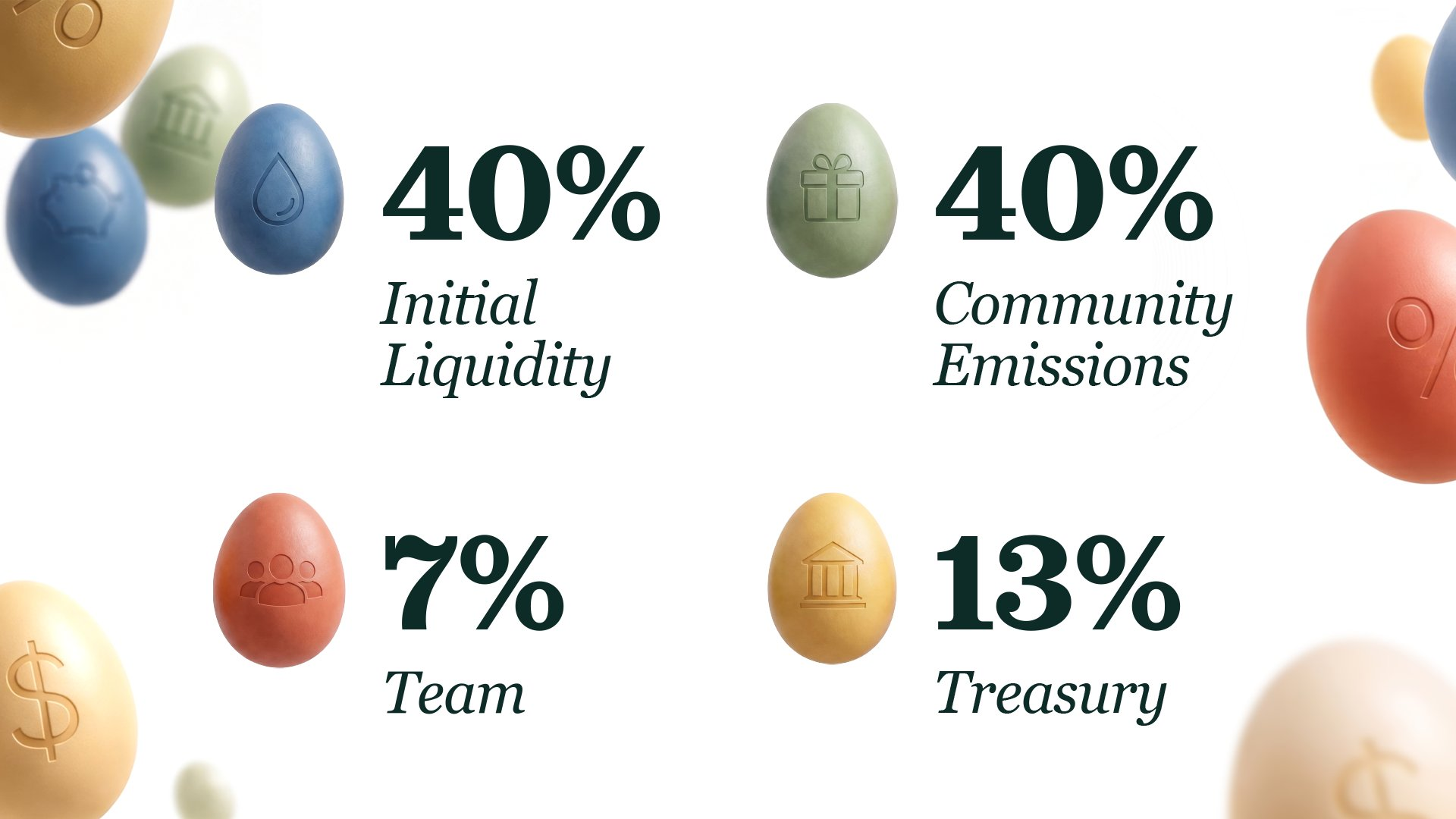
| Allocation | Share | Tokens | Release schedule |
|---|---|---|---|
| Initial liquidity | 40% | 400,000,000 NEST | Initial liquidity allocation |
| Community emissions | 40% | 400,000,000 NEST | Vested over 2 years |
| Treasury | 13% | 130,000,000 NEST | Vested over 3 years |
| Team | 7% | 70,000,000 NEST | 6-month cliff, then vested over 3 years |
The community emissions, treasury, and team allocations are held in non-cancelable Streamflow vesting schedules. The locked allocation can be inspected through the on-chain vesting account.
What NEST is for
NEST is designed to align people who participate in Nest with the growth of the protocol. Its utility is split between benefits that are live today and benefits that may be introduced as Nest products and partnerships expand.
Live today
NEST currently has three direct roles in the protocol:
- it can be staked to receive funded nUSD reward distributions;
- active NEST stake can qualify for Nest Season points; and
- protocol surplus can be used to buy NEST from the market and burn the NEST received.
NEST staking does not make a position eligible for rewards that were funded before it became active. When an unstake is requested, that NEST stops sharing later reward distributions immediately and enters the on-chain cooldown.
Being evaluated
Future NEST utility may include:
- distributing a portion of protocol surplus to active NEST stakers;
- lower borrowing rates or fee benefits for eligible stakers;
- enhanced rewards and benefits in the Nest card; and
- incentives connected to future products and partnerships.
These benefits are not live commitments. Any surplus distribution would require legal review, defined on-chain rules, and a separate protocol update. NEST does not represent equity in Nest or an automatic claim on protocol revenue.
Held, staked, and unstaking NEST
The protocol treats these states differently:
| State | Receives new funded nUSD drops | Earns active-stake points | Can be transferred |
|---|---|---|---|
| Held in a wallet | No | No | Yes |
| Actively staked | Yes | Yes | No |
| Unstaking cooldown | No | No | No |
| Withdrawn after cooldown | No | No | Yes |
Requesting an unstake preserves rewards already earned, but the unstaking NEST is removed from the active total immediately. Future rewards are therefore split only across positions that remain actively staked.
How protocol revenue is routed
Nest Core provides a common revenue path for realized fees and revenue from protocol products. Revenue deposited through this path is accounted for in the following order:
- Outstanding protocol bad debt is reduced first.
- A configured share can be directed to the insurance fund until its target is reached.
- Remaining revenue is directed toward the snUSD target distribution.
- Revenue above the accrued snUSD target becomes protocol surplus.
realized protocol revenue
          |
          v
bad debt -> insurance -> snUSD target -> protocol surplus
                                               |
                                               v
                                      NEST buyback and burn
The exact amounts depend on realized revenue, current liabilities, insurance settings, active snUSD assets, and the configured target APR. A target is not a guaranteed return.
Buybacks and burns
Protocol surplus recorded by Nest Core can be released for a buyback. The buyback workflow exchanges the released USDC for NEST and burns only the NEST actually received from that exchange.
Burning removes those tokens from supply. Buyback size and timing depend on surplus being available and on execution checks such as price and minimum output limits. They are not a fixed schedule or a guaranteed amount.
The Nest stats page reports indexed protocol revenue, buybacks, and NEST burns.
NEST staking rewards
NEST staking rewards use a separate nUSD reward pool. When nUSD is funded into that pool, the staking program assigns it pro rata to the NEST that is actively staked at that moment using a cumulative reward index.
position reward = funded nUSD x position active NEST / total active NESTThis design means rewards must exist in the pool before they can be claimed. An advertised campaign amount is not a permanent emission rate or a claim on all future protocol revenue.
Season points
Season points are a separate campaign system. Active NEST stake can receive a share of the daily points pool alongside other eligible Nest positions. Weights, dates, and eligible categories can change between campaigns.
Points are not nUSD yield and should not be treated as a guaranteed token allocation. See the Points guide and the live Season page for the current rules.
Keep the systems separate
| System | What users hold | What it can provide | Main constraint |
|---|---|---|---|
| snUSD | snUSD shares | Revenue routed toward the target APR | Returns depend on realized revenue and pool accounting |
| NEST staking | Actively staked NEST | Funded nUSD reward drops | Unstaking stops future rewards and starts a cooldown |
| Season points | Eligible protocol positions | Campaign points | Rules and weights can change |
| Buyback and burn | No user position required | A reduction in NEST supply | Requires available protocol surplus and successful execution |
Product benefits can change
Protocol parameters, campaigns, revenue sources, and future NEST benefits can change. The allocation and Streamflow vesting schedules above are separate from those product decisions. Use the app and on-chain state for current values rather than relying on a historical reward amount or snapshot.